Qwen3-VL Abliterated: Which Uncensored VLM to Run?
Qwen3-VL abliterated builds cover 2B, 4B, 8B and 32B dense models plus a 30B-A3B MoE. Pick one by GPU memory, and GGUF needs a separate mmproj file for images.
Key points
- Qwen3-VL abliterated builds are published for 2B, 4B, 8B, 32B and the 30B-A3B MoE.
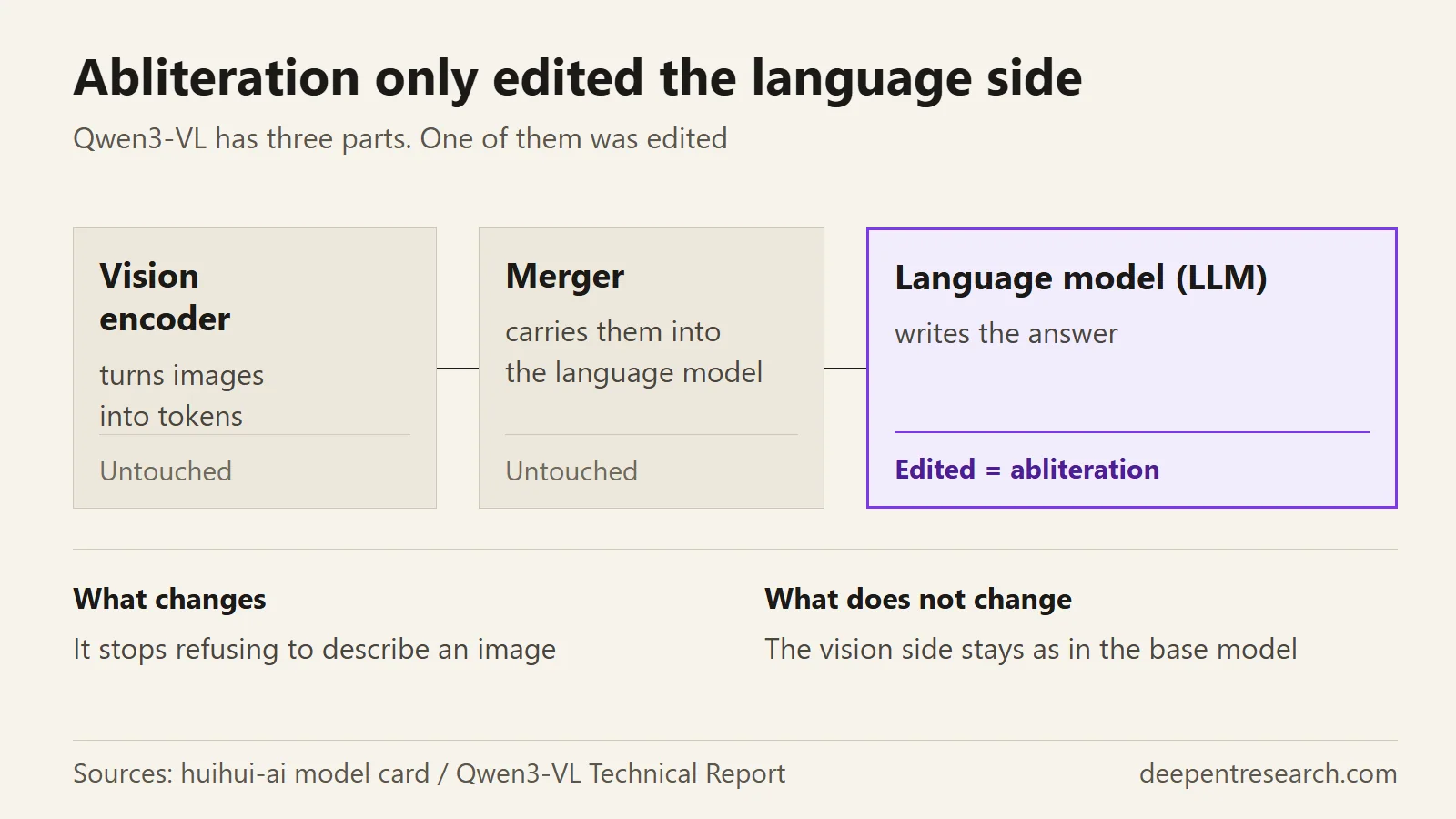
- Abliteration was applied to the text side only, so the vision part is untouched.
- In GGUF, image input needs the separate mmproj file alongside the model file.
Contents
- What is Qwen3-VL?
- What sizes does Qwen3-VL come in?
- Which Qwen3-VL abliterated builds exist?
- What does abliteration change on the vision side?
- Which size should you pick?
- Should you run it with Ollama, GGUF, or Transformers?
- How do you run it with Ollama?
- How do you run GGUF and keep image input?
- How do you run it with Transformers or vLLM?
- What goes wrong with uncensored vision models?
- What is Deepent Research?
- Frequently asked questions
- Disclaimer
Qwen3-VL abliterated builds are published for the 2B, 4B, 8B and 32B dense models and for the 30B-A3B mixture-of-experts model, so the first decision is which one your memory can hold. Ollama lists those five tags at 1.9GB, 3.3GB, 6.1GB, 20GB and 21GB as of October 2026. The second decision is the format, because a GGUF download needs a second file before the model can handle images at all.
The edit behind these builds was applied to the text part of the model and not to the part that reads images, according to the publisher. That boundary decides what you gain: a model that stops refusing to describe a screenshot or a chart, not one that reads them any better. If the refusal was what interrupted your research, the build solves the problem you had.
This guide covers the published sizes, what the edit does and does not change, and the file that people miss when they run these models locally.
What is Qwen3-VL?#
Qwen3-VL is the vision-language series from the Qwen team. Each model stacks three parts: a vision encoder that turns images and video into tokens, an MLP-based merger that feeds those tokens into the language model, and the language model that writes the answer. Text, images and video share a context of up to 256K tokens, and the models are built on Qwen3 backbones (Qwen3-VL Technical Report).
What sizes does Qwen3-VL come in?#
The dense models are 2B, 4B, 8B and 32B. The MoE models are 30B-A3B and 235B-A22B, where the number after the A counts the parameters active per token: the flagship has 235B total parameters and activates 22B of them for every token it writes.
| Model | Architecture | Released |
|---|---|---|
| 235B-A22B | MoE, 235B total, 22B active per token | 2025-09-23 |
| 30B-A3B | MoE | 2025-10-04 |
| 4B / 8B | dense | 2025-10-15 |
| 2B / 32B | dense | 2025-10-21 |
Those dates come from the release notes in the Qwen3-VL repository.
Which Qwen3-VL abliterated builds exist?#
One community publisher, huihui-ai, has collected abliterated versions of the family apart from the flagship. The Qwen3-VL-abliterated collection (last updated 2025-12-15) holds builds for 2B, 4B, 8B, 30B-A3B and 32B. Most sizes ship as an Instruct build and a Thinking build, which is Qwen's reasoning edition, and the 4B model also has an FP8 build for smaller downloads. The 235B-A22B flagship has no abliterated build in that collection as of October 2026.
- 2B — Instruct and Thinking
- 4B — Instruct, Thinking and FP8
- 8B — Instruct and Thinking
- 30B-A3B — Instruct and Thinking
- 32B — Instruct and Thinking
Because these are community edits rather than official releases, the publisher matters as much as the base model. Our comparison of Qwen3.8-27B builds shows how far editions of one base can drift apart, and the huihui-ai overview covers the publisher itself.
What does abliteration change on the vision side?#
Nothing, according to the publisher. The model card for the 8B build states that only the text part was processed and not the image part, and it adds that the edited model "will no longer say 'I can't describe or analyze this image.'" The refusal that blocks image descriptions is gone, while the image-reading ability is the one the base model had (Huihui-Qwen3-VL-8B-Instruct-abliterated).
Abliteration finds the direction in a model's weights that produces refusals and removes it. The method is explained in what is abliteration.
The two statements together mark the boundary of what you are buying. An edited build is not an upgrade for optical character recognition or chart reading, because neither was touched. It is a change to what the model is willing to do with the image it already reads, which is the part that most often stalls image-based research.
Which size should you pick?#
Pick the largest build that fits the memory you have, and drop one quantization level when the fit is close. Ollama publishes a download size per tag, which is a practical starting point: 1.9GB for 2b, 6.1GB for 8b, and 20GB or more for the two largest. Leave headroom above the file size, because a growing conversation takes working memory of its own.
| Tag | Download size | Note |
|---|---|---|
2b | 1.9GB | smallest |
4b | 3.3GB | |
8b | 6.1GB | latest |
30b | 20GB | MoE, 30B-A3B |
32b | 21GB | dense |
| 2b | 1.9GB | |
|---|---|---|
| 4b | 3.3GB | |
| 8b | 6.1GB | |
| 30b (MoE) | 20GB | |
| 32b | 21GB |
The sizes come from the Ollama page as of October 2026. The Ollama guide covers how to allow for context on top of the file.
The interesting pair sits at the top. The 30b and 32b tags are 20GB and 21GB, so size alone will not decide between them. The 32B dense model uses all of its parameters for every token, while the 30B-A3B model activates 3B of its 30B per token. A MoE build of similar download size therefore activates far fewer parameters per token, and the quantization ladder adds a second axis, which the quantization explainer covers. If you are still choosing a model family, the uncensored model roundup covers the alternatives.
Should you run it with Ollama, GGUF, or Transformers?#
Choose by how much setup you want. Ollama handles image input for you and takes one command. GGUF is the right format if you already work in llama.cpp or LM Studio, and it needs the mmproj file next to the model file or images will not work. Transformers and vLLM are the options when you write code or serve several requests from one machine.
How do you run it with Ollama?#
Leave the tag out and Ollama picks the 8b build. The publisher's model card also names a :8b-instruct tag, and the library page lists tags for each size.
ollama run huihui_ai/qwen3-vl-abliterated
That page reports a 256K context window, text and image input, and the vision, tools and thinking capabilities. The model card asks for Ollama v0.12.7 or later, so update before you pull the model.
How do you run GGUF and keep image input?#
Download the mmproj file as well as the model file. The 8B GGUF page lists mmproj-Q8_0 at 0.9GB and mmproj-f16 at 1.3GB, described as a "multi-modal supplement". Without it the model runs as text only.
In GGUF, take the mmproj file alongside the model file, or the model cannot handle images.
The same page shows the quantization ladder for the 8B build, so you can size the download before you start. It also links out to llama.cpp, LM Studio and Ollama, and reported 20,647 downloads as of October 2026.
| Quantization | Size |
|---|---|
| Q4_K_S | 4.80GB |
| Q4_K_M | 5.03GB |
| Q6_K | 6.73GB |
| Q8_0 | 8.71GB |
| f16 | 16.4GB |
How do you run it with Transformers or vLLM?#
Support starts at Transformers 4.57.0 and vLLM 0.11.0, per the Qwen3-VL repository. Transformers is the path for a Python script, and vLLM for a server that answers several requests at once.
If you would rather skip the local setup, Deepent Research accepts image input in the browser. The conditions are on the pricing page.
What goes wrong with uncensored vision models?#
Three mistakes cover most of the trouble: the mmproj file is missing, the download does not fit the machine, and nobody checked the licence. The first looks like a broken model rather than a missing file, because the build answers text and ignores images. The other two cost a wasted download or a licence problem later, and both take a minute to check before you start.
- No mmproj file. A GGUF build without it answers text and ignores images, which is easy to misread as a failed install.
- Wrong size estimate. The download size is the model file alone. Pushing a long context adds more, so leave headroom before you settle on a tag.
- Licence. The publisher's pages list Apache 2.0. Confirm the terms on the page you download from before you plan commercial use.
The publisher states that safety filtering has been significantly reduced, that output may be sensitive or inappropriate, that the models are intended for research and testing, and that it takes no responsibility for the consequences of use.
One distinction is worth keeping. Refusing less is not the same as answering correctly: abliteration removes refusals and leaves mistakes alone, so checking the output stays with you.
What is Deepent Research?#
Deepent Research is a browser-accessible LLM chat service built to refuse as little as possible. It keeps going with research that a standard AI would cut off mid-answer.
- It refuses nothing. We run uncensored and abliterated models with guardrails reduced as far as possible, so prompts a standard AI answers with "I can't help with that" still get a response (Qwen3.5 / Qwen3.8-27B-abliterated, depending on your plan).
- Your input is never used for training. What you look up is used only to provide the service, never to train AI or for any other purpose. Personal data is protected, and our privacy policy is public.
- Try it free. No GPU and no install, just open a browser. In the logged-out trial your conversation isn't saved, so you can start casually.
→ Try it free, no sign-up: https://deepentresearch.com
No question can stop research.
Frequently asked questions#
Are Qwen3-VL abliterated builds official models?#
No. They are community builds made by huihui-ai from the official Qwen3-VL weights using abliteration, which removes the refusal behavior from the model. The base models come from the Qwen team, while the edited versions are published under the huihui-ai namespace and carry the publisher's own warnings and licence notes.
Which Qwen3-VL abliterated size should you start with?#
Start with the largest build your memory can hold. The 2b tag is 1.9GB and the 8b tag is 6.1GB in Ollama, so both fit a modest GPU, and the published sizes are as of October 2026. The 30b and 32b tags are 20GB and 21GB, which takes a large card or a machine with plenty of unified memory.
Why do you need an mmproj file for GGUF?#
GGUF splits a vision model into two files: the model itself and the mmproj file that feeds image features into it. The distribution page calls mmproj the multi-modal supplement and lists it at 0.9GB and 1.3GB for the 8B build. Download the model file alone, and it will answer text but not process images.
Does abliteration change how well the model reads images?#
No. The publisher states that only the text part was processed and not the image part, so image reading stays at the same level as the base model. What changes is that the model no longer refuses to describe or analyse an image, which is the refusal that interrupts most image-based research.
Disclaimer#
This article was drafted with AI assistance and then reviewed, fact-checked, and edited by the Deepent Research team before publication.
It is provided for educational and research purposes and is not intended to encourage unlawful activity or crime.
Where figures are cited, they come from third-party public reports and vendor-published values and may vary with measurement conditions.
How this note was edited and verified
We cross-check primary sources such as official documentation and papers, and organize only what the facts support.
This note was drafted with AI, then fact-checked, expanded, and edited by the operator before publication.
Related notes
Writing With an Uncensored AI: Start a Story, Keep It Going
Tense scenes and technical drafts are where assistants stop. Here is how to write with an uncensored AI: brief it first, work scene by scene, and verify.
Why Does an AI Refuse? Four Reasons and What to Do Next
A refusal can come from four causes: a safety check, missing information, an unclear question, or a glitch or message limit. Read the message to find yours.
What Can You Hand to an AI, and What Should You Keep?
Summaries and background reading are easy to delegate. Personal data and publishing raw output are not. Here is where the line sits, and why, in five checks.
Try it yourself
Deepent Research is an LLM chat service that refuses almost nothing. Everything covered in this note can be tried without downloading anything.